
Stop Guessing When to Water: How a 4-in-1 Soil Meter Guides Plant Care

Learn how to use moisture, temperature, light, and pH readings as plant-care clues without treating one number as a universal watering rule.
Affiliate disclosure: This article contains Amazon affiliate links. I may receive compensation when you click or make a qualifying purchase. As an Amazon Associate, I earn from qualifying purchases.

Watering houseplants looks simple until two pots that appear identical dry at completely different speeds. Pot size, root density, potting mix, light, temperature, humidity, and season all change how quickly moisture is used. A 4-in-1 meter can add another observation to your routine—but it should support plant judgment, not replace it.
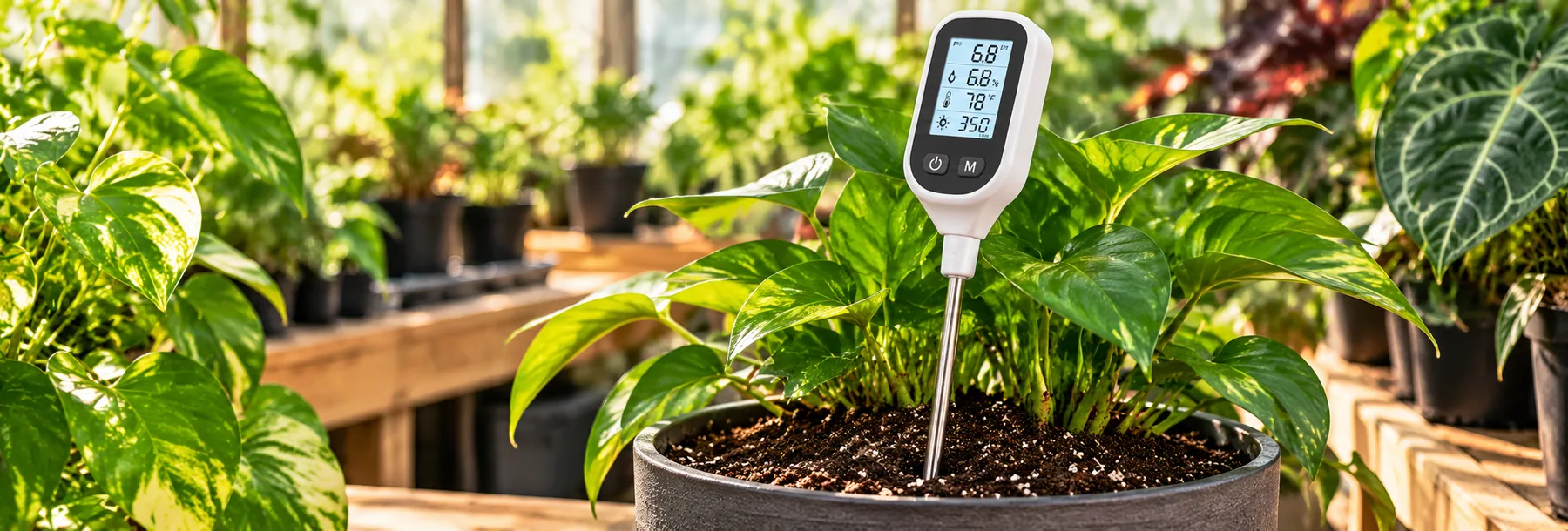
This guide focuses on the YAMRON digital soil meter linked to Amazon ASIN B0DF4TB93J. The listing identifies functions for soil moisture, pH, temperature, and light intensity with a backlit LCD. I have not independently laboratory-tested its accuracy, so the article treats readings as screening information rather than guaranteed scientific measurements.
Why watering by the calendar fails
University of Maryland Extension advises against watering indoor plants on a rigid schedule. A plant’s needs depend on the species, container, growing medium, temperature, humidity, and light. That is why “water every Sunday” can leave one pot soggy while another becomes dry.
A better routine combines visual plant inspection, pot weight, a finger check where appropriate, drainage behavior, and—if you choose—a meter reading taken consistently.
What this 4-in-1 meter measures
| Reading | Useful question | Important limitation |
|---|---|---|
| Moisture | Is this part of the root zone wetter or drier than my previous reading? | One point may not represent the entire pot. |
| Temperature | Is the root zone unusually cool or warm? | Does not replace knowing the plant’s preferred range. |
| Light | How does this location compare with another location or time? | Direction, distance, season, and measurement angle matter. |
| pH | Is there a possible reason to investigate the root-zone chemistry? | Home probe readings can be affected by contact, moisture, media, and calibration; a proper test is better for consequential decisions. |
How to take a more useful reading
- Read the manufacturer’s instructions before inserting the probe.
- Choose a representative location between the stem and pot edge.
- Insert gently; never force the probe through dense roots or hard material.
- Wait for the display to stabilize, then record the value and location.
- Repeat in another part of a large pot when the first reading seems inconsistent.
- Clean the probe as directed after use and store it dry.
Consistency is more informative than chasing a single perfect number. If you always check the same plant at a similar depth and compare readings with leaf condition and pot weight, you can learn what “ready for water” looks like for that specific setup.
How to interpret moisture without overwatering
A low reading is a prompt to inspect—not an automatic instruction to flood the pot. Succulents, orchids, tropical foliage plants, seedlings, and moisture-loving plants do not share the same preferred cycle. Also check whether water can drain freely and whether the mix has compacted.
The interactive guide below demonstrates a conservative decision process. It intentionally avoids claiming that one number is correct for every species.
When the meter is most helpful
- Comparing two rooms or windows over time.
- Checking deeper moisture in a large container after the surface has dried.
- Learning how quickly a newly repotted plant uses water.
- Spotting a wet pocket caused by uneven watering or a poorly draining mix.
- Keeping notes while adjusting seasonal care.
When other methods are better
Use a finger check or pot weight when the container is small and accessible. Use a proper laboratory or Extension soil/media test when pH or nutrient decisions matter. Use a dedicated calibrated light meter when you need quantitative horticultural lighting data. A consumer multi-function probe is convenient because it combines observations, but convenience does not make every reading equally authoritative.
Who should consider the YAMRON meter?
It may suit a gardener who wants a repeatable way to compare moisture, temperature, light, and pH indications across several pots. It may not be necessary for someone who confidently reads a small collection by pot weight and mix condition, or anyone who needs laboratory-grade pH or light measurements.
Frequently asked questions
Can a soil meter tell me exactly when to water?
No single reading can account for species, potting mix, root health, drainage, and season. Use it as one observation.
Should I leave the probe in the pot?
Follow the product instructions. Many handheld probes are intended for spot checks, not permanent installation.
Why do readings differ across the same pot?
Moisture can be uneven, especially after partial watering or when mix pulls away from the pot edge. Check more than one location without damaging roots.
Does a pH reading diagnose fertilizer problems?
No. It can suggest that further testing may be useful, but symptoms can have several causes. Confirm consequential decisions with reliable testing and plant-specific guidance.
Bottom line
The best use of a 4-in-1 meter is to replace guessing with a repeatable observation—not to replace horticultural judgment. The YAMRON model offers four readings in one display and can be a practical learning tool when you interpret trends carefully.
Sources: University of Maryland Extension: Watering Indoor Plants; Penn State Extension: Repotting Houseplants.
A conservative, plant-aware guide for interpreting moisture observations.
Keep exploring
Find more Junecity guides
Browse practical gardening, outdoor living, and DIY articles.Browse the blogShop this guide
Affiliate Picks
Tools & supplies I use and recommend
As an affiliate, junecity.studio may earn from qualifying purchases at no additional cost to you.
Keep growing
Suggested reading

Growing Pink Guava in Connecticut! 😳
Discover how to successfully grow pink guava in Connecticut, even in challenging climates. Learn about the conditions and care needed for this tropical delight.

I’m Never Buying Garlic Again 🧄
Discover how to grow your own garlic at home and never buy it again. This guide covers everything from planting to harvesting.
0 comments
Comments (0)
We love hearing from our community. Share your thoughts, questions, or experience.
Have something to add?
Log in to post, react, share images, and join threads.
Newest First
All Comments
Showing 0-0 of 0
Start the conversation.
Questions and first-hand experience are welcome here.