
How to Propagate Houseplants in Water with a Glass Propagation Station

A practical, stage-by-stage guide to preparing cuttings, watching roots form, preventing rot, and moving water-propagated houseplants into potting mix.
Affiliate disclosure: This article contains Amazon affiliate links. I may receive compensation when you click or make a qualifying purchase. As an Amazon Associate, I earn from qualifying purchases.

Water propagation turns one of the most interesting parts of plant care—the formation of new roots—into something you can watch. A glass propagation station keeps cuttings upright, makes the water level visible, and can help you notice cloudy water or decaying tissue before it becomes a bigger problem.
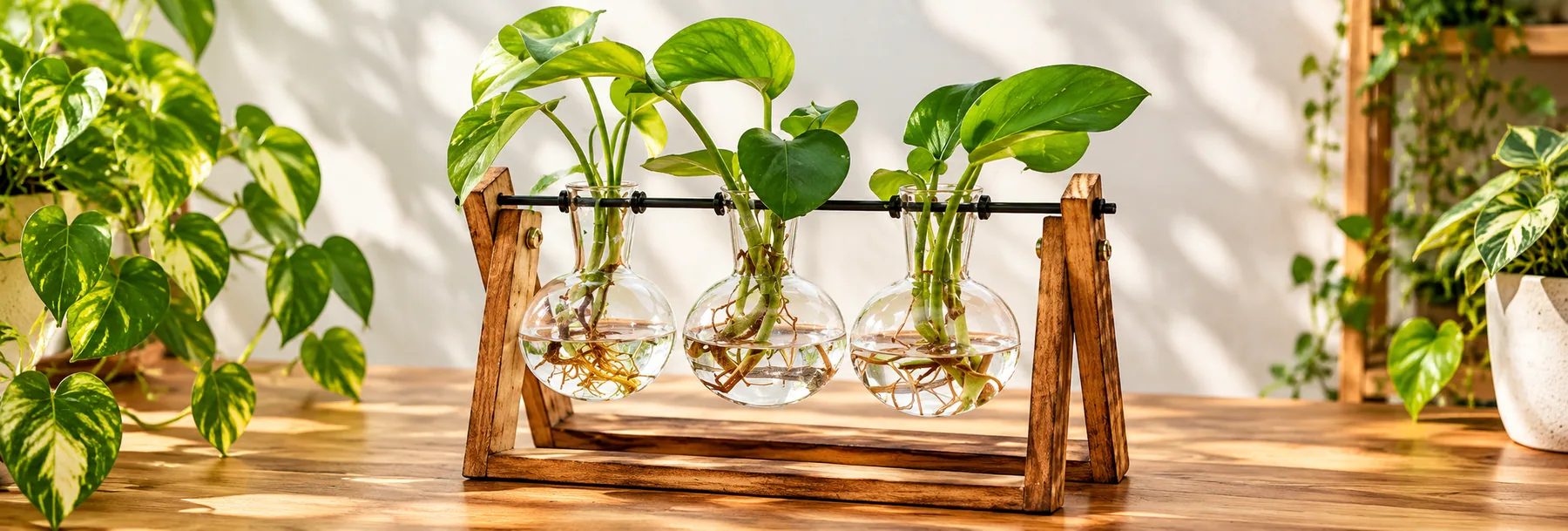
The featured XXXFLOWER station is the exact Amazon listing associated with ASIN B07D29P5Z1. Its listing identifies three glass bulb vases in a wooden stand with a swiveling metal holder. This guide explains the propagation process first, then shows where a decorative station helps and where a plain jar may work just as well.
Start with the plant, not the container
Successful propagation begins with a healthy parent plant and a plant that can actually root from a cutting. Penn State Extension recommends clean tools and healthy material. For many common houseplants, a stem cutting needs at least one node because the node is where new roots and shoots can develop. A leaf without a node may remain green for a while but cannot become a complete new plant in species that require a stem node.
How to prepare a water cutting
- Confirm the species and cutting type. Pothos, heartleaf philodendron, tradescantia, coleus, and many other plants commonly root from stem cuttings; not every houseplant does.
- Use a clean, sharp tool. Make a clean cut below a node.
- Remove submerged leaves. Leaves sitting in water are more likely to decay.
- Place the node in water. Keep foliage above the opening and avoid crowding multiple large cuttings into one narrow vessel.
- Use bright, indirect light. Strong direct sun can overheat a small glass vessel and encourage algae.
- Refresh as needed. If water becomes cloudy or develops odor, clean the vessel and replace it. Top up normal evaporation.
What the three-bulb design changes
| Feature | Practical value | Watch for |
|---|---|---|
| Three separate glass vessels | Lets you compare cuttings or keep varieties separate | Label them so you do not forget the plant or date |
| Clear glass | Makes water level and root development visible | Light can promote algae; clean gently |
| Wooden stand | Keeps the display organized on a desk or shelf | Protect the wood from spills and prolonged moisture |
| Swiveling metal holder | Helps remove and return vessels for cleaning | Support the glass during handling |
Water propagation timeline
Rooting speed varies by species, temperature, light, cutting condition, and season. Penn State notes that some cuttings can take months, so an honest timeline is based on stages rather than a guaranteed number of days. Use the interactive timeline below to review what to inspect from the fresh cutting through transplanting.
When is a cutting ready for potting mix?
Do not wait for an enormous tangle simply because the roots are attractive. Transition when the cutting has several healthy roots capable of being spread gently into a small container and when you can provide consistent aftercare. Use a clean pot with drainage and an appropriate mix. Keep the mix evenly moist during the early transition, but never leave it saturated.
Common propagation problems
The stem turns dark or mushy
Remove decaying material with a clean tool, clean the vessel, and restart with healthy tissue if necessary. Confirm that leaves are not submerged.
The water keeps disappearing
Small vessels lose water to evaporation and plant uptake. Mark a safe minimum level and check regularly.
Roots form but the cutting wilts after potting
Water roots developed in a different environment. Use a small container, an appropriate airy mix, and close monitoring while the plant adjusts.
Algae coats the glass
Move the station away from intense direct light and clean the vessel. Algae is a signal to improve maintenance, not a reason to add unapproved chemicals.
Propagation station versus a jar
| Option | Best advantage | Tradeoff |
|---|---|---|
| XXXFLOWER three-bulb station | Organized, visible display for several small cuttings | Small openings and vessels require careful cleaning |
| Plain glass jar | Inexpensive, easy to replace, often easier to clean | Less stable or visually coordinated |
| Potting mix propagation | Roots develop directly in a growing medium | Root development is not visible |
Who should consider this station?
It may suit someone who enjoys propagating small cuttings on a desk, windowsill, or shelf and wants three separate vessels in one display. It is not necessary for successful propagation, and it may be too small for thick stems, large-leaved cuttings, or plants that are better divided, layered, or propagated directly in media.
Frequently asked questions
Can every houseplant root in water?
No. Propagation method depends on species and plant structure. Confirm the recommended method before cutting.
Do I need fertilizer in propagation water?
Fresh water and a healthy cutting are the priority. Do not add fertilizer unless reliable, plant-specific guidance calls for it.
How much of the cutting should be underwater?
Submerge the node or rooting region, but keep leaves above water.
Does clear glass hurt roots?
Clear glass is useful for observation, but strong sun can heat water and encourage algae. Bright indirect light is generally a safer placement.
Bottom line
The XXXFLOWER station makes propagation visible and organized, but the real success factors remain healthy material, a correct node, clean tools, suitable light, and timely maintenance. Choose it for the display and convenience—not because a decorative vessel can guarantee roots.
Sources: Penn State Extension: Propagating Houseplants; Penn State Extension: Propagating by Cutting or Layering.
An animated stage-by-stage checklist from fresh cutting to transplanting.
Keep exploring
Find more Junecity guides
Browse practical gardening, outdoor living, and DIY articles.Browse the blogShop this guide
Affiliate Picks
Tools & supplies I use and recommend
As an affiliate, junecity.studio may earn from qualifying purchases at no additional cost to you.
Keep growing
Suggested reading

Growing and Caring for Syngonium Three Kings: A Complete Guide
Discover how to grow and care for the stunning Syngonium Three Kings. This guide covers everything from propagation to maintenance, ensuring your plant thrives.
How to Automate Your Garden Watering Without an Expensive Irrigation System
Automate garden watering with a hose timer and drip tubing — a beginner-friendly setup for raised beds, containers, fruit trees, and greenhouses.
0 comments
Comments (0)
We love hearing from our community. Share your thoughts, questions, or experience.
Have something to add?
Log in to post, react, share images, and join threads.
Newest First
All Comments
Showing 0-0 of 0
Start the conversation.
Questions and first-hand experience are welcome here.