
Is Grampa's Weeder Worth It? The Truth About Stand-Up Weed Pullers

Is Grampa's Weeder worth it? A practical, beginner-friendly look at how this stand-up weed puller works, where it shines, and where it falls short.
Short answer: yes, for the job it was designed to do — pulling scattered, taprooted lawn weeds while you stay on your feet. It is not a whole-garden weeding system, and it will not replace a hand tool in a tight bed. If dandelions and sore knees are your main frustration, it earns its place by the door. If spreading, fibrous-rooted weeds fill your beds, you need a different approach first.
That distinction matters: most weeding tools fail quietly, taking the top off and leaving the part that matters underground. You feel finished. The weed does not.
Here in Connecticut, that cycle is familiar: mow a dandelion down in spring, and a week later it is back in the same spot. Around the greenhouses, I would rather spend ten focused minutes pulling weeds properly than an hour chasing the same ones all season.
[Image: Gardener standing upright, centering Grampa's Weeder over a dandelion — placeholder]
What Grampa's Weeder actually is
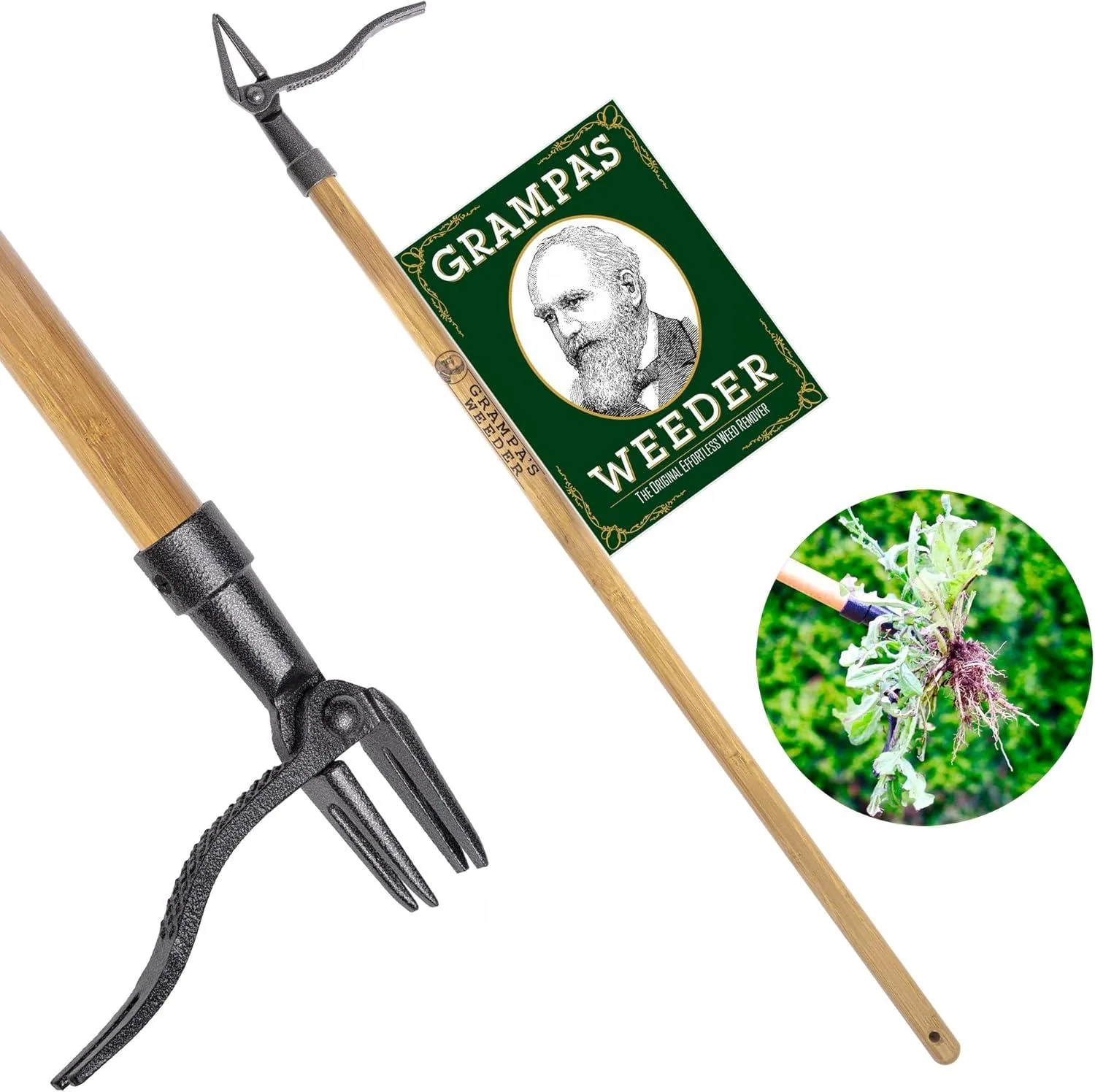
Grampa's Weeder is a long-handled, stand-up weed puller made by Grampa's Gardenware. The manufacturer's listing describes a real bamboo handle about 45 inches long and a four-claw alloy steel head, with a lifetime guarantee from the manufacturer. The design dates to 1913, invented in Seattle, Washington.
The idea is simple. You do not bend, kneel, or yank with your arms. You step, lean, and lift. As you lean, the claws close around the crown and root, and the weed comes out with a plug of soil.
No motor, batteries, or spray — little to break, and little to learn.
How it works, step by step
The manufacturer gives three steps, worth following exactly — most problems come from skipping the second.
1. Center the tool over the weed
Place the claw head directly over the center of the weed, where the leaves meet the ground. This is the crown. If you are off-center, the claws will grab leaves on one side and miss the root on the other.
2. Press straight down, then take your foot off
Press down on the footpad, straight down into the ground. Then — and this is the step people skip — remove your foot.
Standing on the pad while you lean changes the leverage. The tool pivots, it is not held down — if a weed will not release, your foot is usually still on the pad, or you are lifting instead of leaning.
3. Lean the handle toward the footpad
Lean toward the footpad. Do not lift straight up or twist — leaning makes the forks pinch.
Once gripped, lift the tool out, tap the claws over a bucket, check the root came with it, and move on.
[Image: Diagram — center, press and release foot, lean — placeholder]
A good first session
Start with ten weeds, not the whole lawn, in moist soil after rain or watering, where crowns are easy to see.
Work in a slow line across the lawn, bucket in hand, and drop each weed in as you go — seed heads left on the grass can still mature and scatter. When you finish, press large holes closed with your foot and note thin spots for overseeding later.
Why taproots change everything
A dandelion is not just a yellow flower. It is a storage system with a taproot underneath it.
University of Minnesota Extension notes dandelions have a deep, branching taproot reaching 6 inches to 2 feet deep, and new plants can form from broken root sections. Penn State Extension likewise describes a deep taproot that makes hand removal difficult for established plants. Snap the top off, and you have pruned the weed, not removed it.
That is why extension sources repeat the same advice: hand removal works for individual plants or small patches, but remove as much of the root as possible. Montana State University Extension recommends a taproot removal tool, such as a dandelion fork. Nebraska Extension advises pulling small plants when soil is moist enough to remove several inches of root, or cutting the taproot several inches below the crown.
A stand-up puller is, at heart, a taproot tool with a long handle: leverage plus a claw that grips low, near the crown, so the pull aims at the root instead of the leaves. Young weeds come out easily; old dandelions in dry, compacted soil are hard for any tool. Weed moist soil, and weed young plants before they seed.
Different weeds, different results
Not every weed has a taproot, and that is where expectations need adjusting.
Dandelions, thistles, and other taprooted weeds are the best match: one crown, one root system.
Crabgrass and other fibrous-rooted grasses are a weaker match: no single central root to grip, so claws may pull a clump while leaving runners behind. Check what came out and follow up with a hand tool.
Spreading perennial weeds — the kind that send out runners or regrow from root fragments — are the hardest case for any puller. Pulling one shoot does not remove the underground network. For those, pulling is maintenance, not a cure; combine it with thick mulch, dense planting, or thicker turf. In a bed, if you can see one crown and one root, a stand-up puller is a good choice. If you face a mat of roots, loosen the soil with a fork first, or switch to a hand tool.
Soil types: where it works best, and where it struggles
Soil is half the tool.
Moist loam is the sweet spot. Claws sink cleanly and roots release intact. Aim for the day after rain, or water the evening before.
Sandy soil is easy to penetrate but less forgiving. The plug can crumble and the root can slip, so work slowly and check each root.
Clay soil is the test. Moist clay is workable; dry clay hardens and grips roots, snapping stems. If Connecticut clay has baked hard, water, wait for moisture to soak in, and return when soil gives under your thumb. Loosen compacted spots with a fork first.
Compacted lawn soil deserves a note of its own. Dandelions thrive in thin lawns and disturbed soils, according to University of Minnesota Extension, and can indicate compaction. If the same patch keeps producing dandelions, the weed is a symptom — aerating, overseeding, and feeding the lawn will do more over time than pulling alone.
Stand-up puller vs. hand weeder vs. pulling by hand
ToolBest forStanding or kneelingRoot removalTight bedsSpeed on scattered lawn weedsGrampa's Weeder (stand-up puller)Scattered taprooted lawn weedsStandingGood, when centered and soil is moistPoor — long handle is clumsy in tight spacesFastHand weeder / dandelion forkBeds, close planting, precise workKneeling or crouchingVery good, with control over angle and depthExcellentSlow across a whole lawnPulling by handTiny seedlings, soft soilKneeling or bendingVariable — often snaps taprootsGoodSlow, and hard on back and kneesHoeShallow annual seedlings in open bedsStandingPoor for taproots — cuts tops, leaves rootsFairFast for seedlings, not for dandelionsNo single tool wins every row. The stand-up puller wins the row most lawn owners care about — scattered dandelions, without kneeling — while the hand weeder wins where precision matters. Keep both: the stand-up tool for the lawn pass, a hand weeder for beds, edges, and misses.
For a hand tool that pairs well with this one, see the Junecity guide to the hori hori knife — a draft cross-link to activate on publication: What Is a Hori Hori Knife? (do not link https://junecity.studio/blog/what-is-a-hori-hori-knife live yet) — cutting, digging, and precise work in beds.
Lawn care after pulling: do not skip this part
Pulling leaves holes and bare spots — an invitation for the next weed seed.
University of Minnesota Extension puts it plainly: dense, healthy turf is the best defense against dandelion encroachment. Montana State University Extension agrees — keep turf healthy so it outcompetes weeds.
In practice, that means three habits: mow before weeds seed — but do not expect mowing to kill them, since plants regrow from the root; feed and overseed thin patches after a pulling session; and do not scalp the lawn, since taller, healthy turf shades out seedlings. Pulling clears the space; lawn care keeps it filled.
Advantages, honestly stated
- You stay standing. For sore knees, a stiff back, or a long lawn, it turns a kneeling job into a walking job.
- It targets the root, not just the top. Centered correctly in moist soil, the claw grips low and pulls the taproot with the plant.
- No chemicals needed for the weeds it handles. Pulling is mechanical control — useful if children or pets use the lawn.
- It is simple to learn and store. Three steps, no parts to charge, just cleaning and dry storage.
- It makes short sessions useful. Ten minutes after rain can clear a visible patch.
Limitations, honestly stated
- It struggles in dry, hard, or compacted soil. Expect snapped roots if you use it on baked clay without watering first.
- It is clumsy in tight beds. The long handle is a liability between closely planted perennials, under low shrubs, or in narrow raised beds.
- It is not ideal for fibrous or spreading weeds. Crabgrass clumps and runner-forming weeds may need follow-up with a hand tool.
- It leaves holes. In thin turf, those holes need overseeding, or weeds will return to the same bare spot.
- It will not fix a thin lawn by itself. Recurring dandelions usually point to turf density, compaction, or bare soil — not the tool.
- Technique matters more than force. Lifting instead of leaning, or keeping your foot on the pad, is the most common reason a pull fails.
If you buy it expecting it to clear a neglected, weed-choked bed in one afternoon, you will be disappointed. If you buy it to keep a mostly decent lawn free of dandelions without kneeling, it is a good fit.
Troubleshooting
The weed snaps and the root stays in the ground. The soil is probably too dry, or you lifted instead of leaning. Water, wait for moisture to soak in, recenter, press down, remove your foot, and lean — do not twist or yank upward.
The claws grab leaves but not the root. You are off-center, or the weed is too small for the claw head. Recenter, or switch to a hand weeder for tiny weeds.
The tool will not sink into the ground. The soil is compacted or dry. Water first, or loosen the spot with a garden fork. Do not force it by jumping on it.
The weed comes out with a large plug of turf. The soil may be too wet. Press the turf back down, and work when soil is moist but not soggy.
The same weed keeps coming back. A root fragment may remain, or thin turf invites new seedlings. Check with a hand weeder, then overseed the bare patch.
The handle feels awkward. Stand close, keep the handle near vertical before leaning, and let the lever do the work. Fixed length is a real limitation — try a few weeds before committing to a whole lawn.
Weed prevention: pulling less by planning more
The best weeding tool is the one you need less often. A few habits cut workload more than any purchase.
Mulch beds deeply. Mississippi State University Extension notes mulch must be deep enough to prevent weed seed germination and smother existing weeds. Utah State University Extension advises more than 2 inches of organic mulch for good weed control. Keep mulch off stems and trunks, and top it up as it breaks down.
Weed before weeds seed. A dandelion puffball has already done its work. Pull or deadhead before that stage, and bag seed heads if you are unsure your compost gets hot enough.
Fill bare soil. In beds, use mulch or dense planting. In lawns, overseed and feed so grass closes the gaps.
Weed little and often. A ten-minute pass once a week in moist soil beats an all-day session once a season. Young weeds pull easily; old weeds fight back.
Know when to wait a day. If ground is bone-dry and the weed is old and deep-rooted, watering today and pulling tomorrow is the difference between removing a root and snapping it.
Recommended tools and shopping list
These companions make a stand-up puller work well — each earns its place for a specific reason.
- Grampa's Weeder — the featured stand-up puller, for scattered taprooted lawn weeds without bending or kneeling. See it on Amazon.
- Thick garden kneeling pad — for bed work a stand-up tool cannot do.
- Hand weeder / dandelion fork — for tight beds and precise root work.
- Hori hori knife — for cutting and precise bed work; see the forthcoming Junecity guide to the hori hori knife (draft cross-link, do not link live yet). Nisaku Hori Hori Garden Knife on Amazon.
- Shredded bark or straw mulch — to cover bare bed soil and block germination.
- Garden fork — to loosen compacted or clay soil before pulling.
- Bucket or trug — to collect pulled weeds and seed heads as you go.
- Work gloves — for follow-up hand weeding, especially thistles.
[Image: Flat-lay of weeding kit — placeholder]
Frequently asked questions
Is Grampa's Weeder worth it if I already own a hand weeder?
If your weeds are mostly in beds and you do not mind kneeling, a hand weeder may be enough. Grampa's Weeder earns its keep when weeds are scattered across a lawn and kneeling is the barrier that keeps you from weeding. Many gardeners keep both.
Does it really pull the whole root?
It can, when centered, soil is moist, and the weed is taprooted. No puller guarantees a whole root every time, especially in dry or compacted soil. Always check, and follow up with a hand weeder if a fragment remains.
When is the best time to use it?
When soil is moist — after rain or watering — and weeds are young, before they flower and set seed. For hand-pulling, moist soil and young weeds matter more than the calendar.
Will it work on crabgrass?
Partly. Crabgrass has fibrous roots rather than a single taproot, so pieces may remain. Expect follow-up, and focus prevention on thick turf and bare-spot repair.
Does it damage the lawn?
It leaves small holes. In healthy turf, they close as grass fills in. In thin turf, press soil back down and overseed. Leaving a dandelion to seed is usually worse than the hole.
Is it good for people with bad knees or backs?
Standing instead of kneeling is its main advantage. It still requires stepping, leaning, and walking the lawn, so try it on a few weeds first if mobility is a concern, and stop if anything hurts.
How do I store and care for it?
Clean claws after use, let them dry, and store upright in a dry place.
The bottom line
Grampa's Weeder is worth it for a specific gardener: scattered lawn weeds, especially dandelions, roots out without kneeling, moist soil, and follow-up on thin turf.
It is not a cure-all. It will not clear a mat of spreading weeds, thrive in baked clay, or fix a thin lawn alone. Buy it for the job it does well, pair it with a hand weeder for beds, mulch your beds, and feed your lawn.
To keep building that habit, explore more guides at Junecity Studio and browse junecity.studio/shop.
Affiliate disclosure
Some links in this article, including the link to Grampa's Weeder, are affiliate links. If you buy through them, Junecity Studio may earn a commission at no additional cost to you, helping support the site. Recommendations here are based on the tool's design and extension guidance, not on the commission.
Further reading / Sources
These sources were checked during drafting and support the taproot, hand-removal, and mulching claims.
- University of Minnesota Extension — Dandelions: https://extension.umn.edu/weeds/dandelions
- Montana State University Extension — Ode to the Dandelion: https://www.montana.edu/extension/lila_extn/summer2026/odetodandelion.html
- Penn State Extension — Dandelion as a Landscape Weed: https://extension.psu.edu/dandelion-as-a-landscape-weed
- Nebraska Extension in Lancaster County — Spring Dandelion Control: https://lancaster.unl.edu/spring-dandelion-control/
- Utah State University Extension — Mulches and Row Covers: https://extension.usu.edu/vegetableguide/production/mulches-row-covers
- Mississippi State University Extension — Mulches for the Landscape: https://extension.msstate.edu/publications/mulches-for-the-landscape
- University of New Hampshire Extension — Landscape fabric vs. organic mulch: https://extension.unh.edu/blog/2019/05/should-i-use-landscape-fabric-keep-weeds-out-my-perennial-garden
- Colorado State University Extension — Mulches for the Vegetable Garden: https://extension.colostate.edu/resource/mulches-for-the-vegetable-garden/
- Grampa's Weeder product listing (manufacturer description, three-step instructions, bamboo handle, four-claw steel head, lifetime guarantee): https://www.amazon.com/dp/B001D1FFZA?tag=andreferrei04-20
Keep exploring
Find more Junecity guides
Browse practical gardening, outdoor living, and DIY articles.Browse the blogShop this guide
Affiliate Picks
Tools & supplies I use and recommend


As an affiliate, junecity.studio may earn from qualifying purchases at no additional cost to you.
Keep growing
Suggested reading
I’m Selling Cuttings From My Giant Golden Pothos
Explore the process of propagating and selling cuttings from your Golden Pothos. Learn tips for successful propagation, care, and how to ensure your cuttings thrive.
My Chicago Hardy Fig Is Still Producing! 😳
Discover how to successfully grow Chicago Hardy figs in colder climates, including tips on care, protection from frost, and maximizing your harvest.
0 comments
Comments (0)
We love hearing from our community. Share your thoughts, questions, or experience.
Have something to add?
Log in to post, react, share images, and join threads.
Newest First
All Comments
Showing 0-0 of 0
Start the conversation.
Questions and first-hand experience are welcome here.